The impact counter
The article will show how often it was suggested and opened — and how often no ticket came of it. The number every knowledge base has been missing: is the writing worth it?
Documentation that comes to where the question is asked — instead of sitting where nobody looks.
A second delivery address is stored on the customer, not on the order. That way it is available in every future ticket.
An article doesn't wait to be searched for — it shows up where the question is asked. And knowledge doesn't end: it is written, found, put to work, goes stale and gets maintained. That's why this is a circle.
✦ what the AI contributes
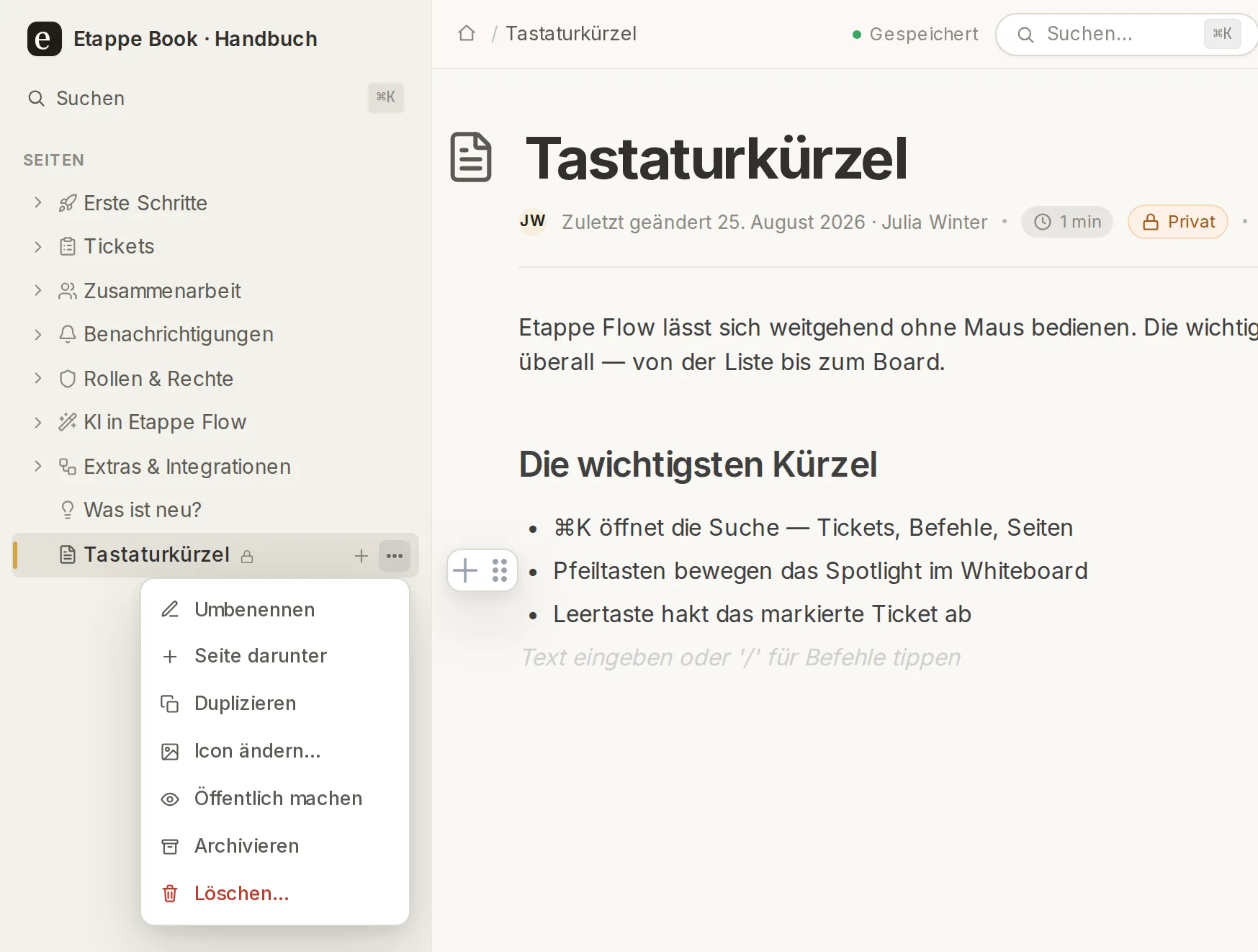
A block editor, not a word processor. Headings, lists, tables, code, images — every element is a block you can grab and move. No Markdown to learn, no HTML to repair.
Every area has its own page tree, as deep as you like, with icons per page. A wastebasket instead of deleting: restorable for 30 days. And an archive for everything that no longer applies but explains why things are the way they are.
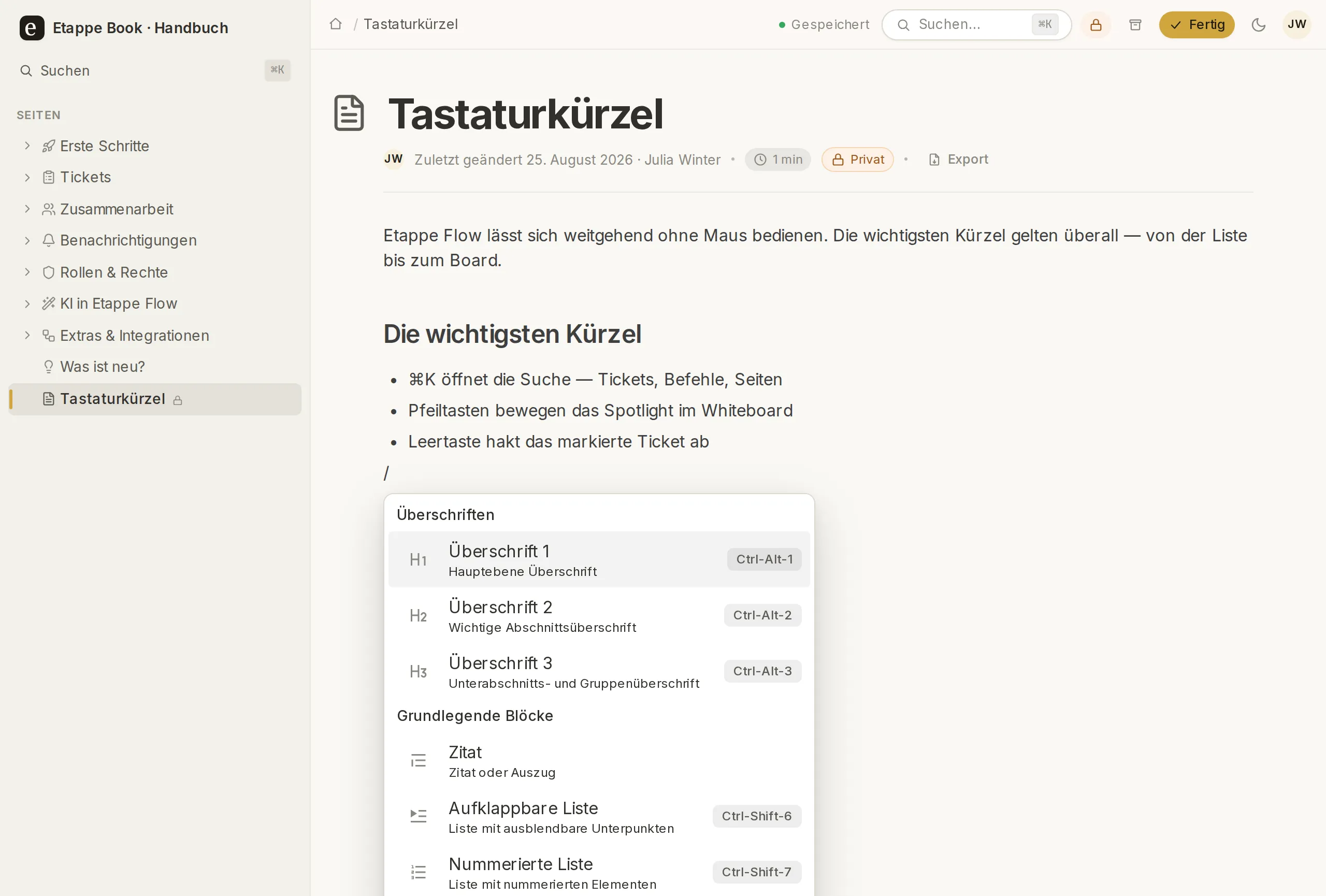
Every page is public or internal — a decision, not a suggestion. It inherits down to every subpage: the new page under an internal chapter is internal, without anyone having to remember.
And the separation doesn't stop at the system boundary: when Flow suggests an article on a ticket, the customer is never even sent internal docs — not hidden, not there.
Full-text search across titles and content, per area — fast, no configuration.
And whoever asks a question in full sentences gets an answer instead of a results list — sources cited. The AI first picks the relevant pages, then answers from exactly those. That detour is the guarantee that the answer comes from your pages, not from model knowledge — and that the citations are right.
How do I add a second delivery address?
That's in Etappe Book — here's the guide:
Answered from Etappe Book — no ticket created
When someone opens a ticket in Flow, Etappe checks whether Book has something on it — by meaning, not by keyword. Matching articles appear as cards right on the ticket. The customer only sees the public share; can be switched off per customer.
Questions that need explaining answer themselves — before someone on your team types them for the fifth time. The best ticket is the one that never happens. That's exactly what Book is for.
Book remembers the state before every change and has the AI summarise in one sentence what changed — not “page updated”, but what is actually different. Changes go to Slack, bundled per page: one message per session, not one per keystroke.
Plus a complete activity log and an author page per person — showing who carries the knowledge, and where one person is a single point of failure.
A token created from the interface and bound to a person gives an outside AI agent access to the pages API: list, read, create, update. Your coding agent documents what it built — in the same run it builds it. No “docs will follow”.
Flow lets outside agents work the ticket. Book lets them write the docs. Nobody else offers this pair.
Existing documentation comes along — structure, images and links survive. No copy-paste project, no lost hierarchy, no dead references.
The import is repeatable: a single page can be imported again without touching the rest. Proven with real content — two areas, the complete tree, including the macro content that standard exports choke on.
Decided and scheduled, not yet shipped — which is why it stands here as an outlook, not in the present tense.
The article will show how often it was suggested and opened — and how often no ticket came of it. The number every knowledge base has been missing: is the writing worth it?
A ticket is solved, the answer sits in the thread — Etappe will propose an article draft from it. The moment knowledge is created is the moment it must be documented.
⌘K will find tickets and articles in the same list. Whoever searches is looking for an answer — not a system.
The question goes to Book and to the ticket archive: “How did we solve this for customer Y back then?” The answer sits in both.
docs.etappe.ai is not a demo but a live Etappe Book instance — the same reading, searching and linking you get for your own documentation. It is written in German for now.
Book comes with Flow — one price model. It is built as the second half of the same system, not as a standalone wiki.
No. Every page is public or internal, and the setting inherits down to every subpage. In the ticket, the customer is only ever delivered the public share.
Yes — with structure, images and links. The import is repeatable and recognises what has already been moved.
From your docs. It first picks the relevant pages and formulates the answer from them — sources cited under every answer.
Yes. Without a stored key the AI features stay off; writing, searching and reading are untouched.
Yes. Via a short-lived token bound to a person it may read, create and update pages — under the same visibility rules, traceable in the history.
Sign up, short onboarding, straight to work — free plan, no credit card. Just bring your Confluence.